

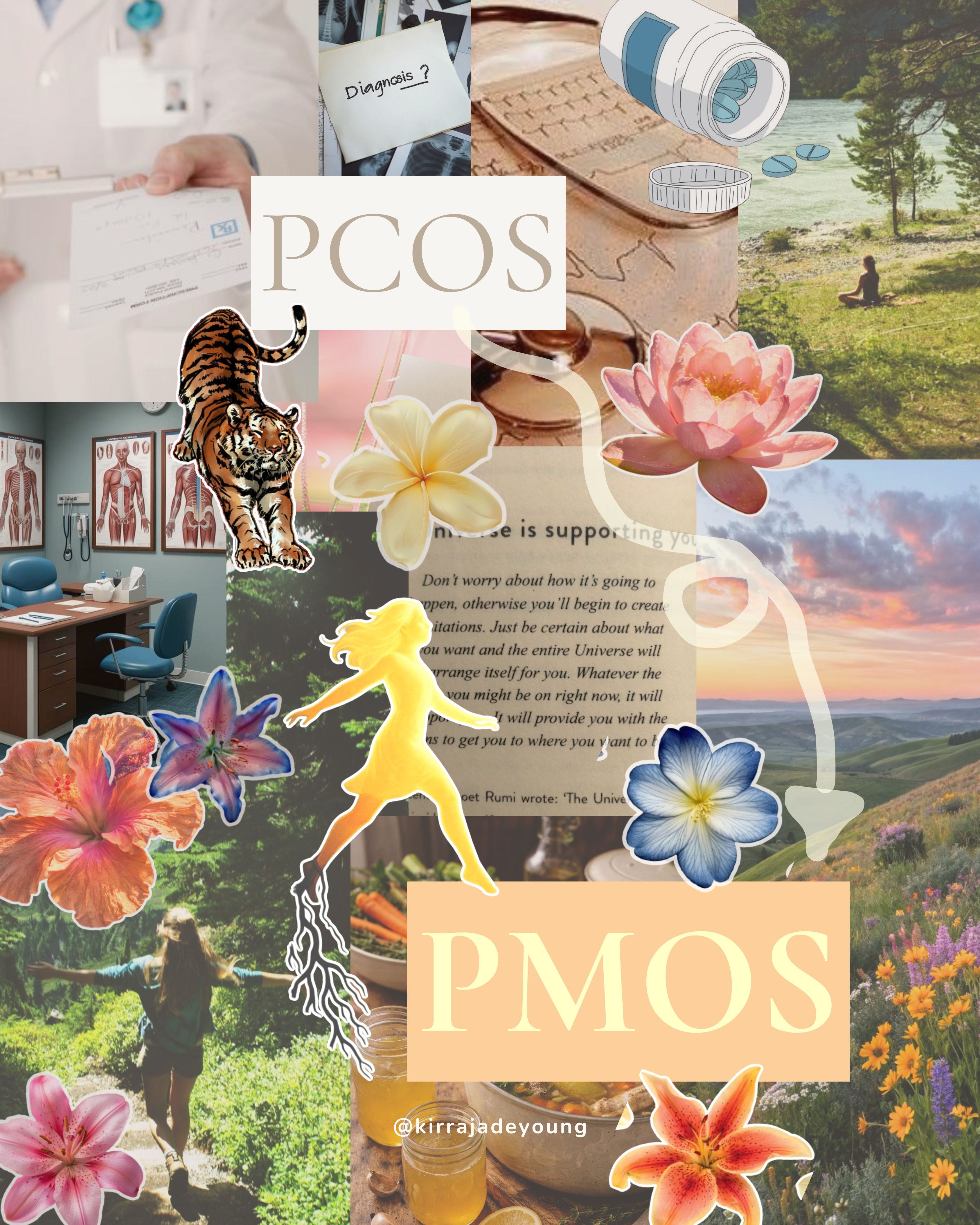
For decades women have been presenting with irregular cycles, sudden weight gain, hair growth or loss, skin that wouldn’t clear, exhaustion, fertility struggles and a prevailing feeling that “something isn’t right” with their hormones and in their bodies.
Approximately 1 in 8 women worldwide struggle with symptoms of PCOS — this diagnosis has been a vastly misunderstood set of symptoms that I also struggled with for years.
PCOS was originally named Polycystic Ovarian Syndrome which implied that the ovarian ‘cysts’ were labeled as the culprit to low fertility and hormonal imbalance. This was never true, and millions of women were labeled with an inaccurate diagnosis, and given band-aids that did not work.
This label was never a true description because there were never really any cysts (expanded below 👇🏽)
The recategorisation into Polyendocrine Metabolic Ovarian Syndrome gives better reference to the multiple endocrine and metabolic systems involved. This completely opens up the stigma around PCOS to a new view, because it’s renamed towards systems that have proven to be dependent on factors such as stress, diet, lifestyle and the body as a whole.
The systems at play
The metabolic aspect refers mainly to insulin, which is the body’s key mechanism for regulating energy and cellular signalling, which has a downstream effect — increasing androgen production (testosterone), suppressing progesterone, and disrupting ovulation.
The most significant addition may be the endocrine system — a network of hormonal axes and the signalling architecture of the body.
At the top of the endocrine stream sits the origin of PMOS: the hypothalamus. Not the ovary. The brain.
In almost every tradition — TCM, depth psychology, chakra systems — this region of the brain corresponds to our deepest centre of instinct, belonging, safety, and the primal intelligence of a body that knows how to heal itself.
The core dysfunction in PMOS is a feedback failure. The hypothalamus stops receiving the “turn it down” signals from its own hormones — the system stays in overdrive.
In somatic therapy this maps directly to a system that is dysregulated and unable to complete its perceived threat cycle. This is the biological manifestation of “pushing through” and being in overdrive without listening to the body’s required needs: decompression, emotional processing, stress reduction and inherent biological needs of quality food, water, movement, sunlight and nature.
How many women are in overdrive and experience symptoms of PMOS? As within, so without. What goes up must come down — it’s just that women are more hormonally sensitive and reactive to the imbalances of our modern living.
One of the most important factors to acknowledge here is that cysts are not named anymore, because they are no longer classified as cysts. What is commonly seen in ultrasounds are follicles that did not fully mature, be let go of, and completed during a monthly cycle — an arrested follicle.
There’s an interesting pattern I’ve witnessed in many women diagnosed with PCOS, including myself, who when intensely struggling with symptoms, also struggle to let go emotionally, and complete emotional cycles, alongside a disconnect from creative expression.
The pattern tends to look something like this:
No adequate “letting go” → holding onto unfinished emotional cycles → disconnection from the natural flow of creative life-force (aka sacral/womb energy)
The rename from PCOS to PMOS didn’t change the condition. It changed the seeing. And after decades of being mapped onto the wrong framework — being told the problem was your ovaries, your cysts, your fertility. A revamped name is empowering because it allows you to take back power over your body and inspires potential for change.
The Feminine Principle: what happens when she feels unsafe and unable to rest
Cortisol is a survival hormone that exists to help the body respond adequately to threat (or stress).
When cortisol stays elevated — because the threat never fully resolved, or rest was never truly safe — the adrenal gland keeps producing. And alongside cortisol, it produces androgens aka testosterone. That’s the body making itself harder, stronger, more self-sufficient. Because somewhere, softness felt dangerous.
This isn’t projection. This is a documented biological pathway. Chronic stress, adverse early experiences, and long-term nervous system dysregulation are all significantly associated with adrenal androgen excess.
The body that learned it had to do it alone — stay alert, stay capable, stay on — often expresses that learning through its hormonal architecture.
A lot of women with PMOS have described — and I’ve felt this too — a baseline state of bracing. A readiness. An inability to fully land. The biology and the lived experience are describing the same thing in different languages.
In a healthy cycle, oestrogen builds and progesterone follows. Oestrogen is the outward, doing, initiating energy — the inhale. Progesterone is the return — the inward, slower, letting go exhale. In PMOS, ovulation often doesn’t happen, and progesterone never arrives. It’s like a constant breath in with no break and exhale.
The spiritual question this raises is one of the biggest most women in the west need to ask themselves: when did it stop feeling safe to rest?
As within, so without. 🦋
Next week I’m releasing a Cord Cutting workshop and meditation here. Subscribe to be notified. 🌀